





It is during times of heavy workloads that an organization requires technology that saves time and minimizes the number of manuals. This is where Workflow Automation comes in. That is, it applies software to mechanize the routine.
Things can be sent by email- such as a form is submitted or spreadsheet updated, or prices modified. However, there are many more options in the market, and it might appear that it is too difficult to select the right one.
This article dives into a detailed Zapier vs Make vs n8n comparison. We’ll look at these as top Zapier alternatives 2026 and overall workflow Automation Tools comparison. In the end, you will have chosen the best workflow automation platform that suits the requirements.
Let’s start with the basics.
What is Workflow Automation?
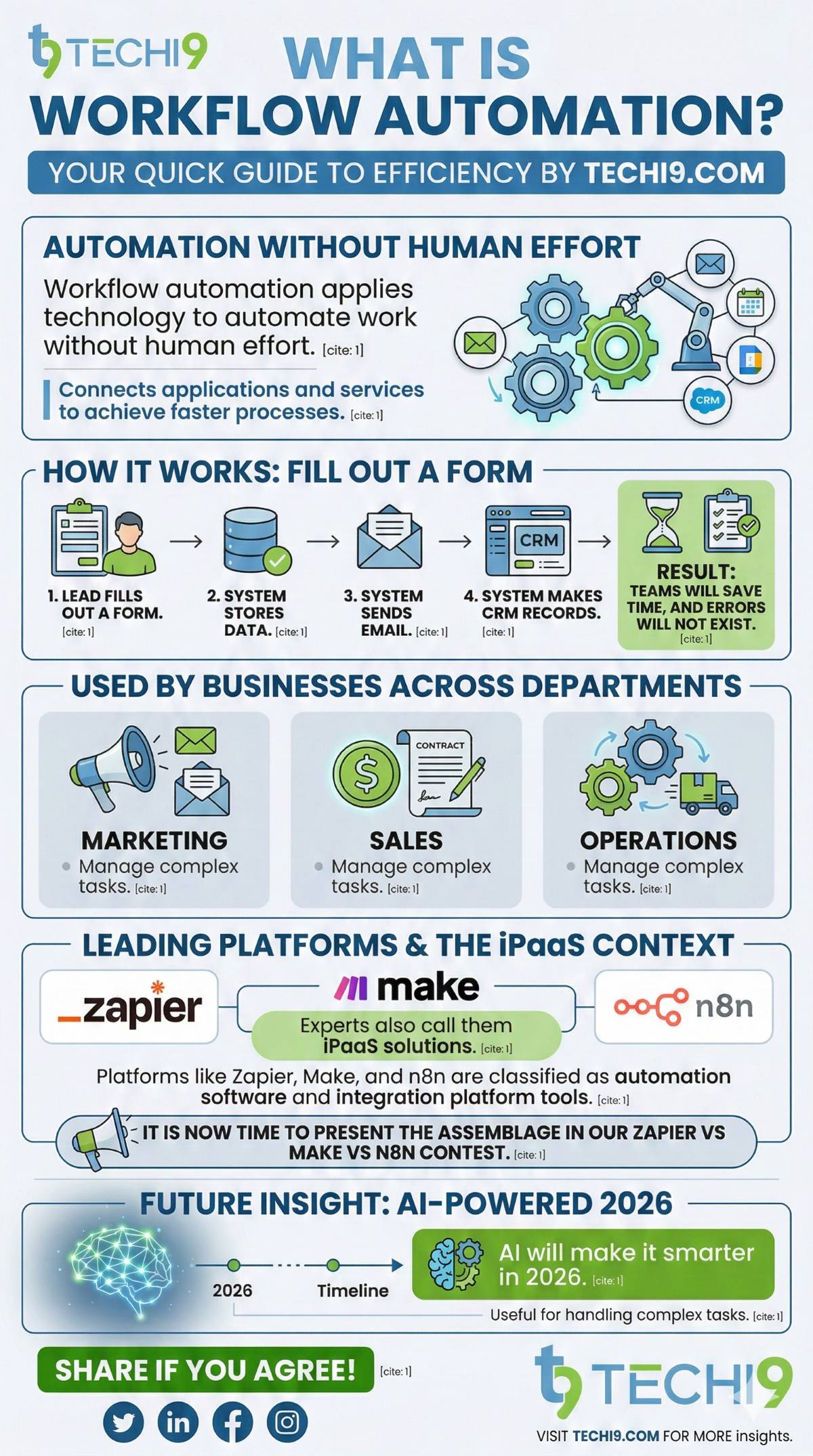
Workflow automation applies technology to automate work without human effort. It connects applications and services to achieve faster processes. For instance, it can link your email to a CRM system.
It is used by businesses in marketing, sales, and operations. AI will also make it smarter in 2026. These tools are useful for handling complex tasks. It is now time to present the assemblage in our Zapier vs Make vs n8n contest.
As an example, when filling out a form, the system can store data, email, and make CRM records when a lead fills out the form. As a result, teams will save time, and errors will not exist. Platforms like Zapier, Make, and n8n fall under Automation Software and integration platform tools. Many experts also call them iPaaS solutions.
Introduction to iPaaS and Integration Platforms
iPaaS refers to a cloud-based technology that integrates various applications and services. It acts as a bridge between tools. In contrast to manual APIs, an integration platform uses visual builders and connector tools. This makes automation faster and safer.
The Zapier vs Make vs n8n comparison is really about which iPaaS model fits your future needs.
Overview of Zapier
Zapier is one of the most widely used automation software, with more than 8,000 applications. It’s like glue for your tools. You create “Zaps,” which are simple workflows.
Founded years ago, Zapier shines for beginners. No coding needed. It works as an iPaaS by linking services quickly. For example, it can post Slack messages from new Google Sheets rows.
Moreover, Zapier added AI features in recent updates. This makes it a strong contender in workflow automation tools comparison. But it’s not perfect for everyone. We’ll see why later.
In the Zapier vs Make vs n8n discussion, Zapier often wins for ease of use.
Zapier Key Features
- 6,000+ app integrations
- Beginner-friendly setup
- Strong SaaS ecosystem
- Reliable cloud hosting
Zapier works best for small teams and solo founders.
Zapier Strengths in 2026
Zapier continues to lead in usability. For example, creating a workflow takes minutes.
Additionally, Zapier handles maintenance, updates, and scaling. Therefore, users focus only on outcomes. This makes Zapier attractive when comparing Make.com vs Zapier for non-tech users.
Zapier Limitations
However, Zapier has limits.
- Complex logic is hard
- Costs rise quickly
- Limited data manipulation
In Zapier vs Make vs n8n, Zapier often feels restrictive for advanced teams.
Zapier Pricing Explained
The biggest concern is zapier pricing.
Zapier charges per task. As workflows grow, costs increase sharply. For example, high-volume automation becomes expensive fast.
This is why many teams look for Zapier alternatives 2026.
Overview of Make (Formerly Integromat)
Make, once called Integromat, is a visual integration platform. It offers over 3,000 apps to connect. Users build “scenarios” with drag-and-drop.
It’s more flexible than some rivals. You can handle complex logic easily. As an automation software, it excels in data manipulation. For instance, filter data before sending it.
In 2026, Make stands out for its balance of power and price. It’s a top Make.com vs Zapier alternative. In addition to it, it promotes AI integrations to smarter workflows.
Make is powerful and flexible in the debate between Zapier vs Make vs n8n.
Make Key Features
- Visual workflow builder
- Advanced data handling
- API-level control
- Strong error handling
Make sits between simplicity and control.
Why Make Is Popular in 2026
Make appeals to marketers, analysts, and growth teams. It handles logic that Zapier struggles with.
For example, data transformation in Make is smooth and visual.
This is why many compare Make.com vs Zapier when scaling automation.
Make Limitations
However, Make is not perfect.
- Learning curve exists
- UI can feel busy
- Documentation can overwhelm beginners
Still, in Zapier vs Make vs n8n, Make often wins on flexibility.
Make Pricing Explained
Many users ask about Integromat pricing.
Make uses operations-based pricing. This is typically more cost-effective than Zapier for large workflows.
As a result, Make is often seen as a better value among Zapier alternatives 2026.
In Zapier vs Make vs n8n, n8n is the rebel.
Overview of n8n
n8n is an open-source workflow automation. It is connected in a building block fashion. Great for tech-savvy users. You can self-host it for free. This gives control over data. As a connector tool, it has about 1,000 integrations but allows custom ones.
n8n is ideal for developers. It handles AI and complex tasks well. In our Zapier vs Make vs n8n analysis, it’s the most customizable. Self-hosting makes it a unique n8n self hosted option.
n8n Key Features
- Self-hosting option
- Open-source flexibility
- Advanced logic
- Strong developer control
n8n fits teams that want ownership.
Why n8n Is Gaining Popularity
Privacy laws and cost control matter more in 2026. Therefore, n8n self hosted setups are growing fast. Teams avoid per-task fees and gain full data control.
This makes n8n a serious contender in Zapier vs Make vs n8n.
n8n Limitations
However, n8n is not beginner-friendly.
- Requires technical setup
- Maintenance is your job
- UI is less polished
So, n8n suits developers and tech-first companies.
n8n Pricing Explained
n8n offers free self-hosted usage. Paid cloud plans exist for convenience. n8n self-hosted is difficult to compete with for cost-centric teams.
Head-to-Head: Zapier vs Make vs n8n
Looking at Zapier and Make or n8n, it usually depends on one point, one factor: the level of control and the rate of output. All three are solutions to solve automation, yet they apply to completely different mindsets.
- The easiest way to enter is Zapier. When faster and easier are more important than bendability, Zapier is virtually frictionless.
- Make it sit in the middle. It gives you visual control, deeper logic, and better value, but asks you to think a bit harder.
- n8n is for builders. If customization, ownership, and cost at scale matter, n8n clearly pulls ahead.
In short:
Zapier wins with ease.
Make wins on power-to-price ratio.
n8n wins on flexibility and long-term scale.
Quick Comparison Table: Zapier vs Make vs n8n
All three are top workflow automation tools comparison picks. They differ in depth and ease.
| Feature / Tool | Zapier | Make | n8n |
| Ease of use | Very easy | Moderate | Technical |
| Learning curve | Low | Medium | High |
| Visual workflow builder | Limited | Advanced | Advanced |
| App integrations | 6,000+ apps | 2,000+ apps | Growing library |
| Custom logic & branching | Basic | Strong | Very strong |
| AI & advanced automation | Basic AI steps | Deep AI logic | Full AI + code |
| Self-hosting option | ❌ No | ❌ No | ✅ Yes |
| Pricing model | Per task (can get expensive) | Per operation (cheaper) | Free / low-cost scale |
| Best for | Beginners, non-tech users | SMBs, marketers, ops teams | Developers, startups, enterprises |
| Open-source | ❌ No | ❌ No | ✅ Yes |
Zapier feels simplest. In contrast, Make handles complexity. n8n offers freedom.
Make.com vs Zapier: What Actually Changes in Real Use?
Zapier vs Make is a common upgrade path. People usually start with Zapier and move to Make when workflows get messy.
- Zapier is faster to launch. You can build useful automations in minutes.
- Make is cheaper at scale and far more powerful once workflows grow.
- Zapier hides complexity. Make exposes it visually.
If your automation needs more than “when X happens, do Y,” Make starts to feel like the smarter long-term tool.
Zapier Substitutes in 2026: Why n8n is Leading
When considering Zapier alternatives 2026, the one that stands out due to one factor is control, n8n.
- You own the workflows.
- You control hosting and data.
- You are not punished with higher costs as automation volume grows.
For teams serious about automation, n8n is less “plug and play” and more “build it your way.” That trade-off pays off fast once workflows scale.
Best Tool by Use Case
- Beginners & solo creators
Zapier is the safest choice. Easy to establish, almost zero learning. - SMBs & growing teams
Make balances cost, flexibility, and visual clarity. Excellent in selling, operations, and sales processes. - Growth Hackers and scale-driven firms
n8n is built for this crowd. It is future-proofed with custom logic, APIs, and self-hosting.
Pros and Cons Breakdown
Zapier Pros and Cons
Pros
- Massive app ecosystem
- True no-code experience
- Fast setup and onboarding
- Basic AI features built in
Cons
- Task-based pricing becomes expensive
- Limited branching and logic
- Less control over complex workflows
Make Pros and Cons
Pros
- Powerful visual workflows
- Unlimited routes and conditions
- Strong AI and data handling
- Better pricing for heavy usage
Cons
- Steeper learning curve than Zapier
- No self-hosted option
- Can feel overwhelming at first
n8n Pros and Cons
Pros
- Cloud of self-hosted or cloud.
- Very cheap on a large scale.
- Code-level customization
- Ideal for complex and AI-driven workflows
Cons
- Requires technical setup
- Smaller ready-made app library
- Not beginner-friendly
Bottom Line
- If automation is a quick win for you, go Zapier.
- If automation is a business function, go Make.
- If automation is infrastructure, go n8n.
Make decisions based on where you are now rather than where the marketing pages would want you to be.
Business Type Use Cases (Expanded)
Solo Founders and Creators
Zapier is a perfect fit in this case, and frankly, it is not even a close contest.
Individual founders, freelancers, and creators tend to be concerned with 3 things, namely speed, simplicity, and the ability not to ruin anything accidentally. Zapier checks all three boxes. You can set up automations in minutes without thinking about logic trees, APIs, or edge cases. Polished integrations with the most common tools, such as Gmail, Notion, Stripe, Google Sheets, and social platforms already exist, and you are seldom stuck.
Typical use cases include:
- Auto-publishing content across platforms
- Syncing payments to spreadsheets or CRMs
- Simple email follow-ups and lead capture
- Saving form responses automatically
The big win is mental bandwidth. Zapier enables you to create your product, audience, or content, rather than manage it like babysitting. Certainly, prices can go up later, but in the solo phase, speed is more important than efficiency.
Marketing and Growth Teams
For marketing, ops, and growth teams, Make offers the best balance between power and usability.
These teams deal with messy data. Leads come from ads, forms, CRMs, analytics tools, and email platforms. Make’s visual workflow builder makes it easier to see how data flows and where things can break. You get advanced routing, filters, and transformations without writing code, which is perfect for non-developers who still need serious logic.
Common scenarios include:
- Multi-step lead enrichment and scoring
- Syncing CRM, email tools, and ad platforms
- Automating campaign reporting
- Handling conditional workflows like “if paid user, do X; if free user, do Y”
Make shines when Zapier starts to feel restrictive. There is a learning curve, but once teams cross it, they rarely want to go back. Cost-wise, it is also more predictable for teams running high-volume or complex workflows.
Startups and Enterprises
This is where n8n really earns its reputation.
Startups and businesses are concerned about size, pricing, and ownership. n8n enables self-hosting, custom code, and API integration, and in many ways, this is exactly when automation becomes core infrastructure and not a side tool. You are not confined to per-task pricing, and all data and execution are controlled by you.
Strong use cases include:
- Product event pipelines and internal tooling
- Custom integrations not supported by no-code tools
- High-volume workflows where cloud pricing gets painful
- Compliance-driven environments needing data control
The trade-off is obvious: n8n needs technical skills. Setup, maintenance, and security are on you. This is a feature, however, not a bug, for companies with engineering capabilities. In the long term, n8n has often been able to offer the lowest cost and maximum flexibility of the three.
Quick takeaway
- If automation is a helper, choose Zapier.
- If automation is a growth engine, choose Make.
- If automation is infrastructure, choose n8n.
Select the tool that best fits the current level of automation importance to your business, rather than the level at which you wish to appear in the future.
Future Trends for 2026
AI Becomes the Core of Automation
Automation is moving beyond mere triggers and actions. In 2026, AI will become a decision-maker, with context and execution.
Key shifts:
- AI agents handling tasks end to end
- Context-aware workflows that adapt in real time
- Fewer hard rules, more intent-based automation
Among current platforms, n8n is leading open-source AI automation. It is more flexible and thus easier to assemble these AI agents, interrelate models, and retain data privacy.
Rise of Agent-Based and Autonomous Workflows
Workflows are becoming self-directed.
What to expect:
- Multiple AI agents collaborating in a single workflow
- Agents managing other automations
- Reduced human intervention for routine decisions
This trend favors platforms that support deep logic and customization over simple connectors.
iPaaS Evolution and MCP Standards
iPaaS platforms are evolving with interoperability standards like Model Context Protocol (MCP).
Impact:
- Easier integration across tools and AI models
- Less vendor lock-in
- Stronger multi-platform compatibility
Additional automation will not be proprietary-based or standards-based, but rather based on standards.
Which Is Better The One to Pick in 2026?
There is no universal winner. The right choice depends on how important automation is to your business and how much control you actually need.
Zapier — when speed matters
Most suitable with solitary founders, creators, and non-technical groups.
- Fastest setup
- Huge app library
- Simple trigger-action workflows
Limit: Gets expensive and restrictive as complexity grows.
Make — when flexibility matters
Best for marketing, growth, and ops teams.
- Advanced logic and branching
- Visual workflows, easier debugging
- Better value for multi-step automations
Limit: learning curve.
n8n — when control matters
Best for startups, enterprises, and dev-led teams.
- Full data and workflow ownership
- No per-task pricing at scale
- Custom code and APIs
- n8n self hosted for privacy
Limit: requires technical setup and maintenance.
Quick decision guide
- Need fast results → Zapier
- Need balance and value → Make
- Need control and scale → n8n
Test real workflows. The tool that feels simple and dependable is the right choice.
FAQs:
What is the main difference in Zapier vs Make vs n8n?
Zapier is the simplest for beginners. Make offers more flexibility. n8n is customizable and self-hostable.
How does zapier pricing compare to others?
Zapier starts free but scales expensively. Make and n8n are cheaper for high use.
Is n8n self hosted secure?
Yes, you control your data. An ideal choice for those who prioritize privacy.
Can these tools act as iPaaS?
Absolutely. They integrate apps like true iPaaS platforms.
Conclusion & CTA
The question of Zapier vs Make vs n8n lies in the level of control, flexibility, and scale required in 2026. Zapier is uncomplicated, maintains a balance between overall abilities and functionality, and n8n places advanced teams with all ownership rights. You will never have some kind of general winner, but the appropriate fit for your workflow.
Still unsure? Test real use cases today. Compare attributes, pricing, and limits (hands-on) and commit. The smarter Zapier vs Make vs n8n you follow, the sooner your automation will be profitable.


