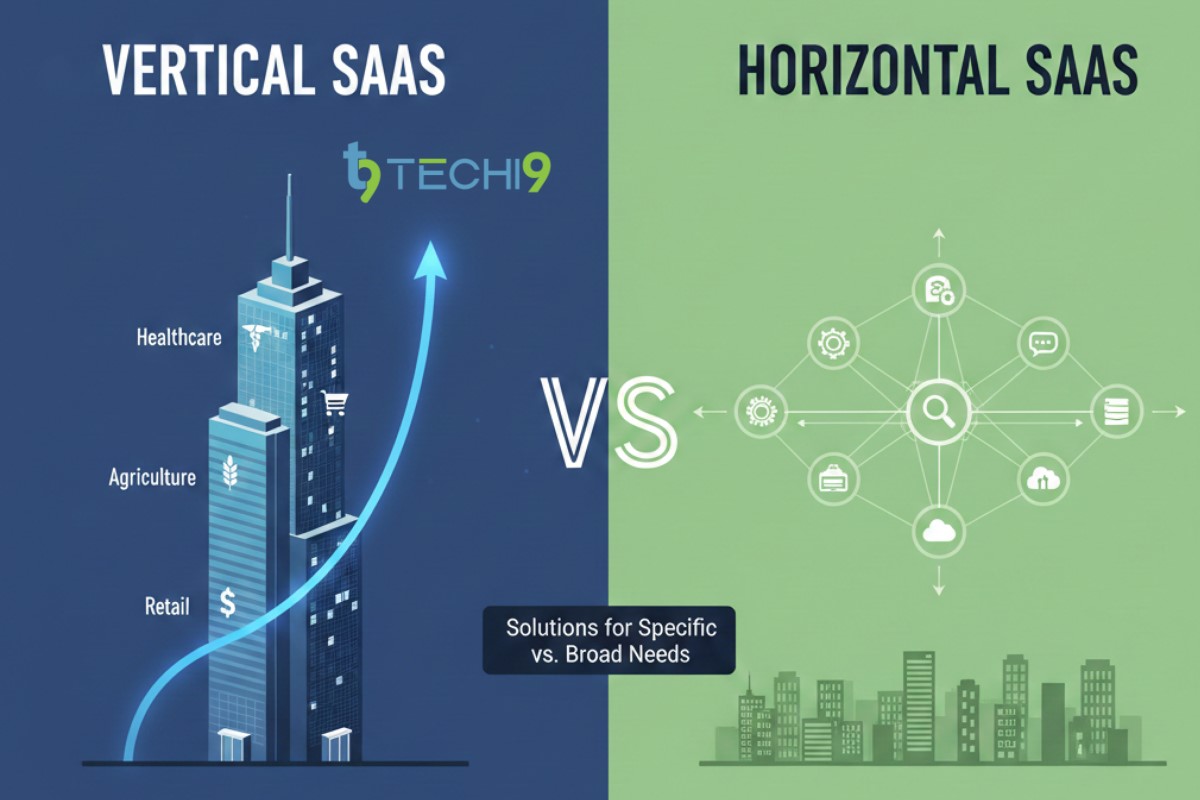





A startup may succeed or fail because of the choice of the business model. There are two popular horizontal SaaS and vertical SaaS. In basic terms, general tools in horizontal SaaS are used in numerous industries, whereas vertical SaaS brings solutions that apply to one industry. This decision will never be more important to startup founders than in the year 2026.
This article describes both with assessment of where the actual opportunity exists as well as a concise suggestion of which way to go with your startup.
What is Horizontal SaaS?
Horizontal SaaS is defined as a type of software that can be applied to numerous industries and categories of business. Consider tools that any company can have.
In more detail: Horizontal SaaS can be defined as software that is developed to cater to a wide range of industries and business processes. It provides generic applications such as customer relationship management (CRM), accounting, or communication platforms. These are products that are versatile and would attract a variety of markets.
Horizontal SaaS businesses seek to capture as many clients as possible in their numerous sectors. Their products address some of the issues that are widespread in businesses, irrespective of industry. Examples can be such popular tools as Salesforce, Slack, and QuickBooks.
However, horizontal SaaS reaches everyone. This broad appeal drives huge growth. As a result, it dominates the market today.
The reasons startups tend to select horizontal SaaS:
- Massive total addressable market (TAM): Due to the number of industries that can implement your product.
- Scaling ability: In case the product is highly relevant, it can grow in a variety of sectors.
- Smoother to explain a more general value proposition.
But the trade-offs:
- Strong competition: Numerous competitors that compete in related broad markets.
- Less differentiation: In case you cater to all, your product may not be highly specialized.
- Increased churn risk: As they will change their minds and find a tool that is more appropriate to them.
In short: horizontal SaaS is about breadth over depth.
What is Vertical SaaS?
Vertical SaaS is focused on a particular industry or market niche and develops software tailored to that workflow.
In more detail: The product is industry-specific, i.e., healthcare clinics, construction companies, and law practices. It is successful in knowing the pain points, language, compliance, and workflow in the industry.
By comparison, Vertical SaaS gives attention to particular issues in a single industry or a niche. This implies that the software is very customized to fit unique demands.
In an example, a lawyer tool is efficient in both tracking cases and billing to clients. A second one is used to manage tables and orders by restaurants. This richness generates fanatical users. The customers are loyal due to high switching costs. Yet, the market stays small. You chase fewer buyers. Growth can slow fast.
In addition, its development requires a profound understanding of the industry. Without specialists, startups have a hard time with it.
The reasons startups tend to select vertical SaaS:
- Earlier strong product-market fit: You are perfectly certain who you are serving, and you are allowed to specialize.
- Higher customer retention: When you serve the niche needs, the customers will remain.
- Less competition in many niches: Reduced competition among direct competitors in strictly defined markets.
But the trade-offs:
- Smaller TAM: This is because you narrowed down your scope by targeting a niche.
- Go-to-market may be slower: There are fewer leads, and sales cycles can be much longer in niche markets.
- Knowledge of the industry: To succeed, a person must have knowledge of the target industry.
In short: Vertical SaaS is one of depth rather than breadth.
Horizontal SaaS vs Vertical SaaS: Head-to-Head in 2026
To begin with, we will compare some of the important dimensions and discover what a startup would desire in 2026.
Market size and growth potential
- Horizontal SaaS has massive potential since it can be adopted by numerous businesses across all industries.
- Vertical SaaS can have smaller opening markets with less competition and increased customer value.
Retention and customer acquisition cost (CAC)
- Horizontal SaaS tends to be a higher CAC as you are hitting wide, heterogeneous audiences and numerous segments.
- Vertical SaaS tends to enjoy a semi-lower CAC (target market) and greater retention (maximum product-mouth fitness).
Differentiation and the competition
- Horizontal SaaS: It is more challenging to differentiate; there are many competitors.
- Vertical SaaS: Competitors in the niche are fewer, thus more differentiation is possible.
Speed to product-market fit
- A horizontal fit between a SaaS product and its market. There are many types of users, and many industries to learn about.
- In the case of vertical SaaS, it is easier to lock in fit faster by focusing on a niche and addressing its pressing issues.
Scaling and growth path
- Horizontal SaaS is scalable in industries when the product is widely applicable.
- Vertical SaaS scales differently, conquer one niche, then perhaps move on to other verticals.
2026 trends impacting both
- The emergence of no-code/low-code and AI will result in expedited product development and better integration into workflows.
- Vertical SaaS is becoming investor-friendly due to the unit economics (greater retention, reduced churn) in niche markets.
Key Differences Between Vertical and Horizontal SaaS
| Feature | Horizontal SaaS | Vertical SaaS |
| Market Reach | Broad, across multiple industries | Narrow, focused on specific industries |
| Product Complexity | General features for varied use cases | Deep, industry-specific functionalities |
| Competition | High, numerous broad-market players | Lower, niche market with specialized players |
| Customer Retention | Moderate to high depending on product | Typically higher due to tailored solutions |
| Scalability | High, can scale across industries | Moderate, scaling within niche segments |
| Pricing Strategy | Usually tiered subscriptions based on users/features | Premium pricing due to customization |
| Sales Cycle | Shorter, volume-based sales | Longer, relationship-based sales |
Should Startups Focus on Horizontal SaaS or Vertical SaaS in 2026?
Horizontal SaaS or Vertical is determined by the plans to achieve, abilities, and experience of a startup.
Advantages of Focusing on Horizontal SaaS
- Availability of a greater number of potential customers.
- Increased prospects of faster growth through a scalable product.
- Water is made easier to validate the market by meeting universal business needs.
- The possibility of collaborating in broad ecosystems.
Advantages of Focusing on Vertical SaaS
- Reduced market competition in the capitalized market.
- Strong customer loyalty because of market fit.
- Premium pricing and upsell prospects.
- Ability to get high-level niche issues on a substantive level.
Factors to Consider When Choosing
- Knowledge: Do you know a specific industry?
- Resources: Does it have the ability to develop a product that is broad and scalable or a highly specialized one?
- Market Size: Does your target market or the market in general have enough people who would desire your product?
- Competition: How congested is the area in which you would like to join?
- Growth Strategy: Would you make quick wins or long-term sustainable growth?
Where Should Startups Focus in 2026?
If I were advising a startup founder today, here’s how I’d break it down:
If you’re early stage, limited resources, domain expertise
Lean Vertical Saas. And if you have a profound knowledge of an industry (e.g., health clinics, legal firms, supply chain of agriculture), then making a vertical SaaS product should be your smarter bet. Why? Since it is possible to achieve product-market fit more quickly, it becomes essential to a small segment of customers and establish high retention and unit economics.
If you have broad ambition, strong team & capital, and want huge scale
Consider horizontal SaaS A lot of marketing, brand building, and in many cases, a longer runway will be required. The competition and cost are as big as the prize.
Hybrid / “focused horizon” strategy
Another valid path: Keep expanding upwards, developing traction and high metrics, and then go horizontal in industries near the initial industry or the feature set more generally. This allows you to have the intensive fit of vertical and the expansion ability of horizontal.
Important caveats:
- When your team has a very broad vision and is looking at creating a huge horizontal platform on the first day of the existence of the business, make sure that you have the resources and the point of difference to make it pull off.
- Monitor the parameters: Churn, CAC, and LTV. In case horizontal starts pulling those, tilt to pay more attention to it.
- Listen to customers. The more vertical or horizontal a SaaS is, the better off its ability in resolving pain, i.e., not merely adding features.
Key Considerations Before Picking Your Model
The following are some of the questions to consider before committing to one model:
Am I well-versed in a niche?
In case yea – natural. Otherwise, you could have difficulties in fitting domains.
What’s the total addressable market (TAM)?
The market should also be large enough to do business, even though it is a niche. If too small – risk.
What is my competitive landscape?
For horizontal: What is the number of similar broad tools?
For vertical: Do we have legacy incumbents?
How strong is my go-to-market (GTM)?
For vertical: Network and industry access is more important.
For horizontal: Universal marketing and brand territory is more.
What are my resources and runway?
Horizontal is usually more time and more capital-intensive.
Vertical can get to cash flow as quickly as possible, but can slow down in scale.
Pros and Cons of Horizontal SaaS for Startups
Horizontal SaaS shines for ambitious founders.
| Pros of Horizontal SaaS | Cons of Horizontal SaaS |
| Reaches massive markets; the SaaS industry is worth hundreds of billions. | Competition is intense, with major players already leading. |
| Attracts diverse customers quickly across retail, tech, finance, and more. | Marketing costs rise because you must reach many sectors. |
| Secures investor interest more easily due to huge market potential. | Features stay general, so deep customization becomes difficult. |
| Success stories prove the model works; Slack scaled to billions by serving all teams. | Broad focus can weaken specialization. |
| Builds brands that become widely recognized across industries. | Even with drawbacks, startups must stand out with UX, speed, or AI. |
| AI in 2026 boosts horizontal SaaS, letting companies add smart features across the board. | AI also levels the battlefield, increasing pressure to innovate. |
Why Vertical SaaS Often Traps Startups
Vertical SaaS may appear as a secure option that would allow rapid gains due to niche orientation. Nevertheless, the reality of most startup cases differs:
- Market Size Caps: Vertical SaaS focuses on small industries. To illustrate, the healthcare vertical SaaS market’s value is in billions, and the horizontal SaaS market’s value is trillions.
- Regulatory Hurdles: Total industrial change in the regulations can put all users on hold, and development can slow because of the risk of obsolescence of the products.
- Absence of Domain Expertise: Companies going through a start-up are not necessarily well-versed in the industry, and this makes the development process more time-consuming and costly.
- Hidden Churn: Customer retention might seem to be long-term, but eventually, it stops due to market saturation.
- Early Acquisitions: Acquisitions of many vertical SaaS startups occur before they have reached much scale. Unicorns Founders can sell small in comparison to horizontal SaaS unicorns.
Conversely, Horizontal SaaS startups usually create large, scalable companies in industries without these restrictions.
Market Trends Favoring Horizontal SaaS in 2026
Several changes in 2026 indicate the increased merit of Horizontal SaaS:
- AI Integration: AI is readily integrated into horizontal SaaS products, which offer the reporting and automation opportunities of a universal character.
- Persistent Remote Work: Expansive SaaS work systems and approaches to communication remain as pervasive as ever in industries.
- Economic Uncertainty: The first kind of cut is made by businesses on niche-specific subscriptions towards a versatile horizontal solution.
- Consolidation: Large SaaS companies buy vertical niche tools, which are often horizontal platforms as their main ecosystems.
- Blistering Development: According to market projections, as of 2025, Horizontal SaaS will be developed to $250+ billion, versus vertical growth.
Horizontal SaaS is at least a survival and scale in an uncertain market to many startups.
Real-World Examples of Horizontal SaaS Winners
Horizontal SaaS is home to household names:
- Slack: Modernised the communication in all industries.
- Notion: General-purpose note-taking, project management, and processes.
- HubSpot: Drives marketing and sales teams of startups to companies.
These firms ran the wide attraction program well. In the meantime, vertical SaaS offers such hits as Veeva that are small but specialized.
Funding and Valuation: Horizontal SaaS Pulls Ahead
The reason why investors prefer horizontal SaaS is its widespread popularity in the market:
- The best horizontal SaaS companies are valued at 50x the revenue.
- The range of vertical SaaS valuations is 10-20x.
- Salesforce has been an example of a multibillion-dollar (horizontal giant.
- Horizontal SaaS startups are more financed and have larger exits, thanks to the opportunity of unlimited upside.
Founders looking to maximize valuation often lean toward horizontal SaaS strategies.
The Future: Why Horizontal SaaS Dominates Long-Term
AI is turning SaaS around the world:
- General horizontal tools acquire intelligent use that all individuals can access.
- Vertical SaaS is not able to keep up with the constraints on specialization.
- The horizontal platforms will acquire the vertical add-ons through market consolidation.
- Technological changes give incentive to multiflexible and multivariate software.
Horizontal SaaS is thus placed to spearhead software innovation and market development during the decade. Betting on horizontal SaaS in 2026 will position startups in a position of long-term success.
Frequently Asked Questions (FAQ)
Q1: What is the difference between vertical SaaS and horizontal SaaS?
Vertical SaaS is industry-specific and has a specialised workflow. Horizontal SaaS is used in lots of industries with general applications.
Q2: Can a startup switch from horizontal to vertical SaaS (or vice versa)?
Yes. A few horizontal SaaS firms take the path of developing vertical niche products. Most of the time, switching entails re-conceptualization of product-market fit, GTM strategy, and the current team structure.
Q3: Is vertical SaaS more profitable than horizontal SaaS?
It depends. The vertical is likely to have more retention and more margins; the horizontal has a bigger scope and expansion. Profitability relies on execution, market, and model.
Q4: For a startup with limited resources, which model is better in 2026?
In most cases of the startups that are small in their initial stages and have very limited resources, secondary specialization in the form of a vertical niche would provide a better probability of success in 2026.
Conclusion: Where Should Startups Focus in 2026?
In the case of startups in the year 2026, both Horizontal SaaS and Vertical SaaS can be an option with unique trade-offs.
Horizontal SaaS is also ideal where the objective is to scale quickly and be able to permeate the market. The rivalry is, however, stiff and demands a high degree of innovation and marketing expenditure.
On the other hand, Vertical SaaS would give startups a chance to dominate a niche position with tailored offerings and to generate a customer base to attract long-term growth.
The question that Startups have to ask themselves before deciding which place to look at relates to how much they know in the industry, the availability of resources required, and their vision in the long run.